

Wieliczka Salt Mine: Poland’s Underground Wonder Near Kraków

Centuries of mining and devotion meet in the underground chapels of Poland’s Wieliczka Salt Mine.
Posted September 2, 2026
About 10 kilometers southeast of Kraków, the Wieliczka Salt Mine preserves more than seven centuries of work beneath the town that bears its name. Visitors descend into chambers, chapels and galleries shaped by generations of miners. What now draws travelers underground began as a royal industrial enterprise built around salt.
The mine extends across nine levels and roughly 245 kilometers of galleries, reaching 327 meters at its deepest point. Visitors see only a small part of that network, but the route shows how labor, faith, engineering and art became connected underground.
Salt, Wealth and the Polish Crown
Rock salt mining at Wieliczka began in the 13th century. At a time before refrigeration, salt preserved food, supported trade and generated valuable income for Poland’s rulers. The mine became part of the Kraków Saltworks, a royal enterprise that included nearby Bochnia and the administrative castle in Wieliczka.
Generations of miners expanded the underground complex while developing new ways to extract salt, control water and support enormous chambers. Horses also worked below ground, hauling salt and materials through the galleries.
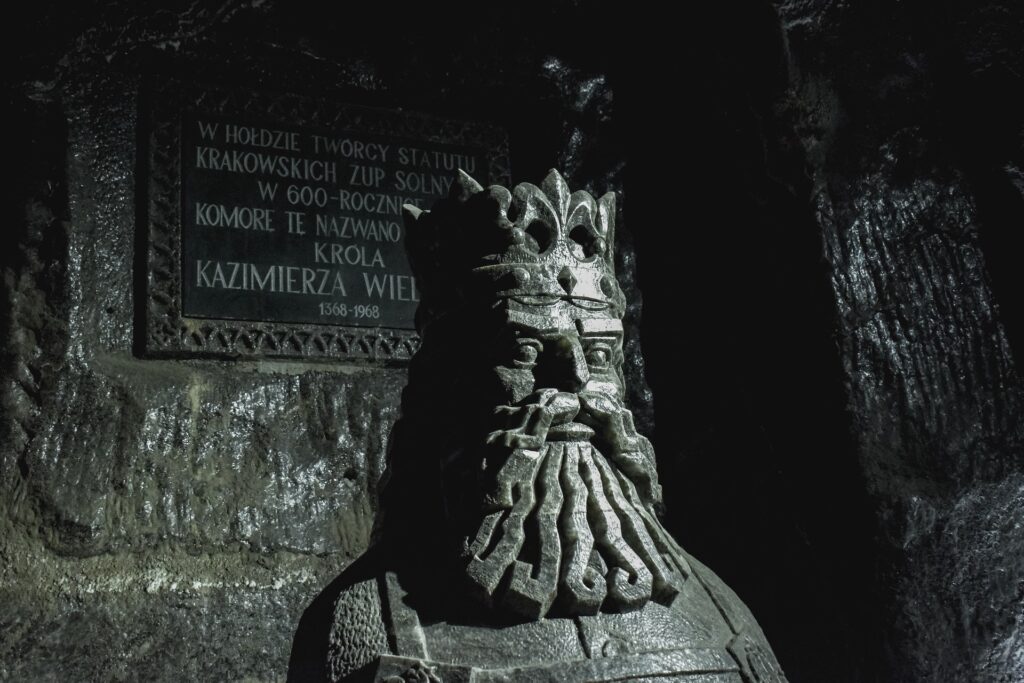
Miners transformed blocks of rock salt into sculptures that preserve Wieliczka’s religious and working history.
Commercial salt mining ended in 1996. Wieliczka still produces salt by evaporating natural brine. The site now operates as a museum, heritage attraction, event venue and medical center.
UNESCO added Wieliczka to the World Heritage List in 1978, when it became one of the first 12 properties inscribed. UNESCO expanded the property in 2013 to include Bochnia Salt Mine and Wieliczka Saltworks Castle. Together, they trace the development of European salt-mining technology from the 13th through the 20th centuries. Readers can discover more historic places through the World Footprints collection of UNESCO World Heritage stories.
The Chapel of St. Kinga
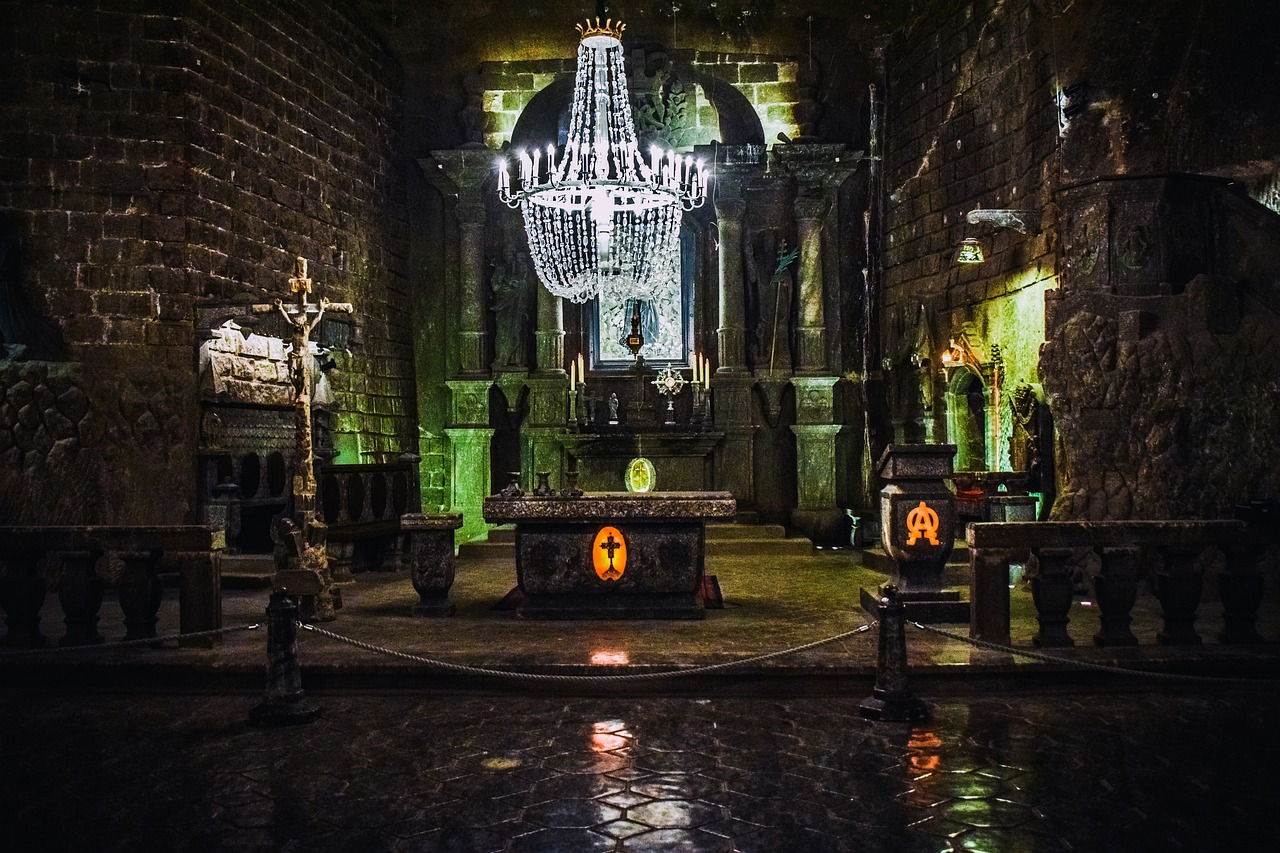
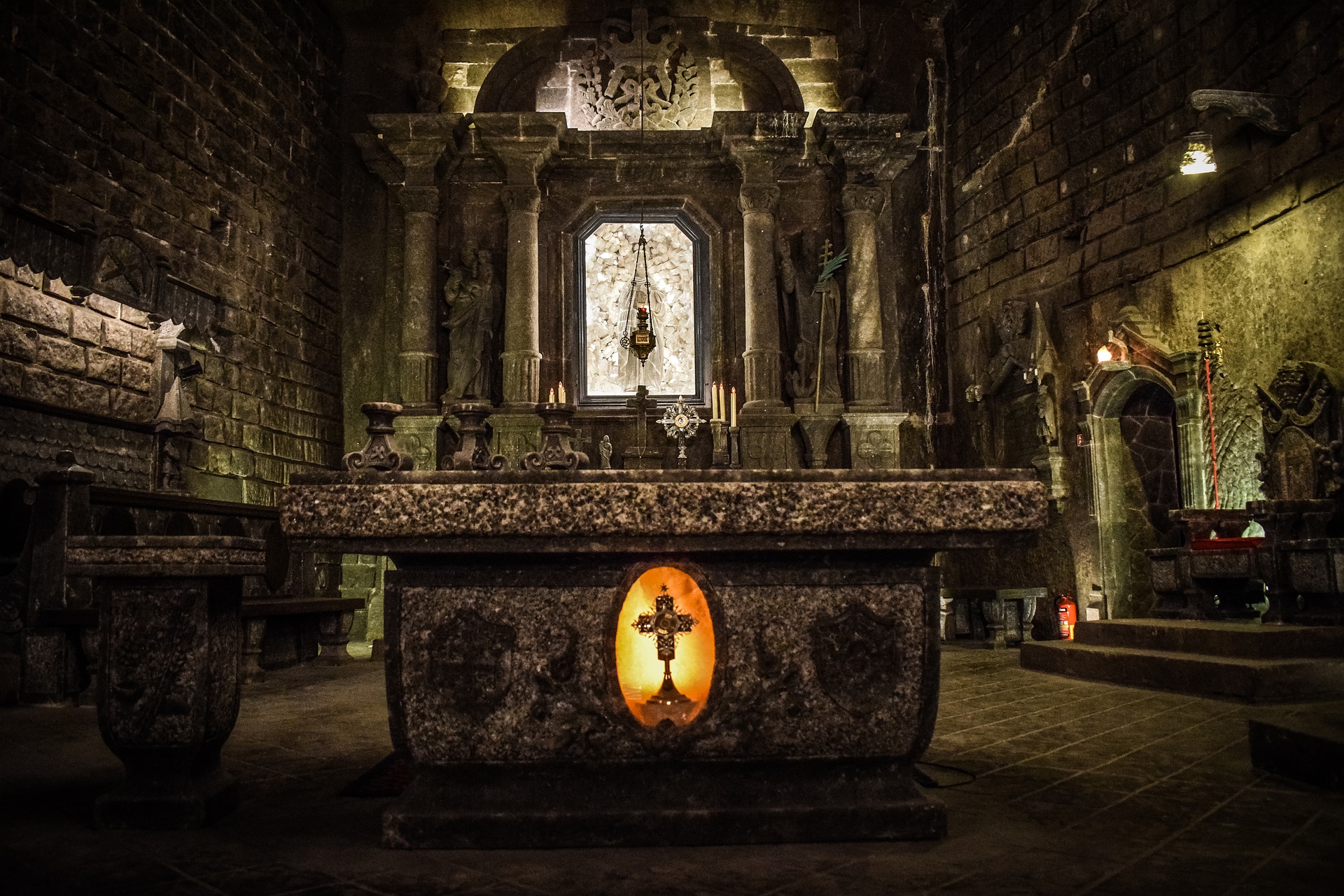
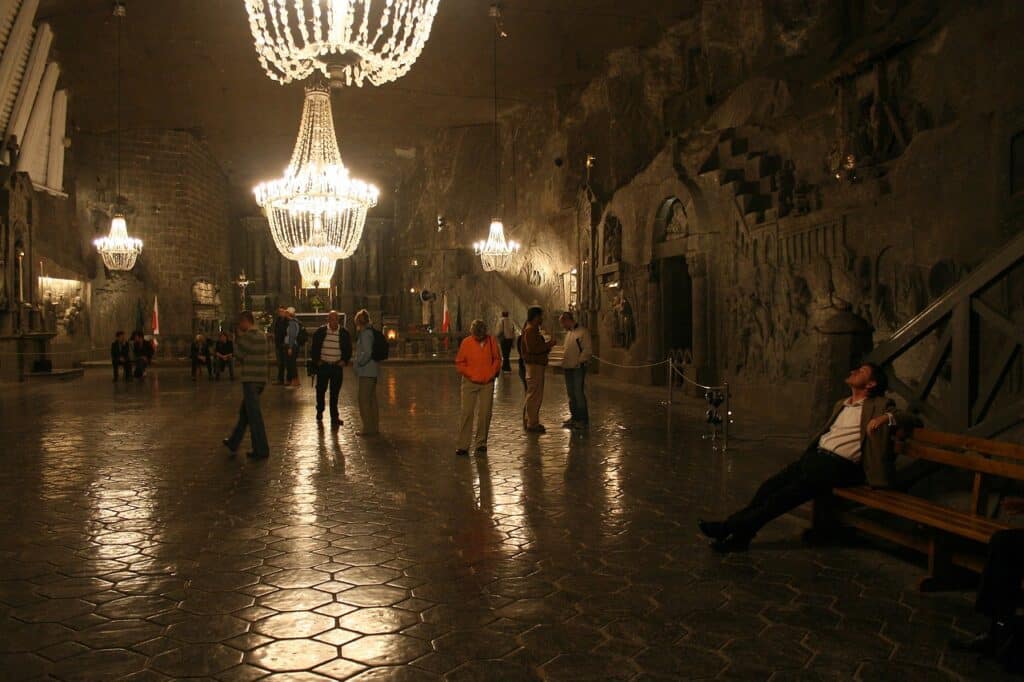
The mine’s best-known chamber is the Chapel of St. Kinga. Despite its cathedral-like scale, miners created much of its ornamentation by hand. Salt forms the floors, altars, religious figures and wall reliefs. Even the chandeliers incorporate carefully worked salt crystals.
A relief modeled after Leonardo da Vinci’s Last Supper is one of the chapel’s most photographed works. Visitors will also see a salt statue of Pope John Paul II, along with a carved pulpit and elaborate altars.
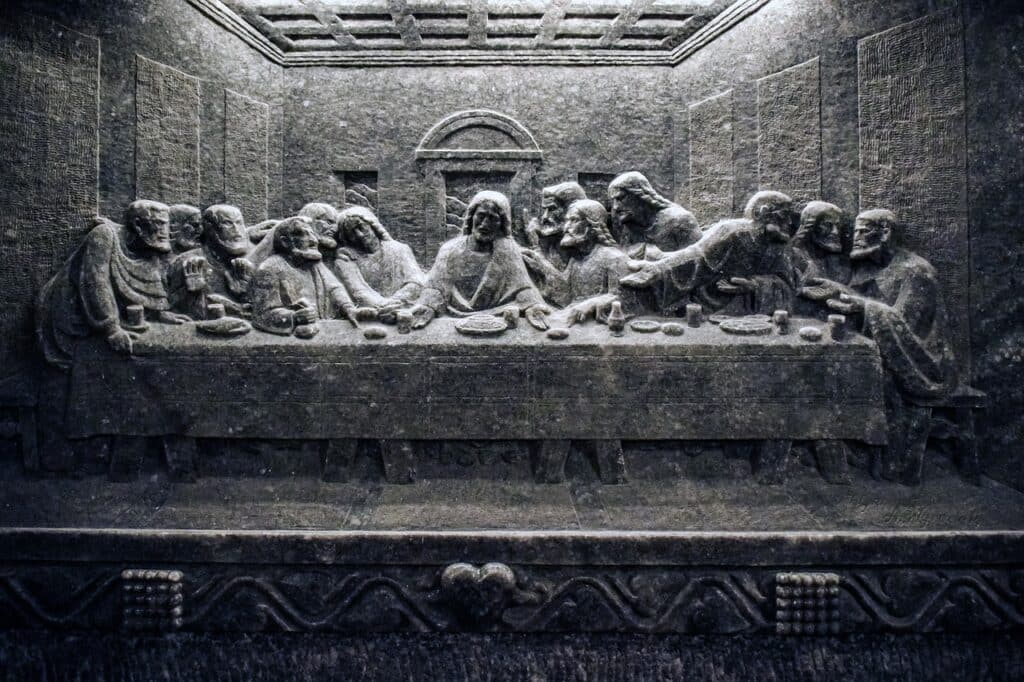
A rock-salt interpretation of Leonardo da Vinci’s Last Supper is among the chapel’s best-known works.
Faith was part of daily life underground. Mining was dangerous, and the chapels gave workers places to pray before or after a shift. Over time, Wieliczka’s miners created other sacred spaces and devotional works underground, including St. Anthony’s Chapel and the wooden Golgotha.
St. Anthony’s Chapel is also included on the Pilgrims’ Route, although moisture and the passage of time have softened some of its salt-carved details.
-

- Religious carvings reveal the faith and craftsmanship of generations of Wieliczka miners.
-

- The Chapel of St. Kinga features salt-carved altars, reliefs and chandeliers more than 100 meters underground.
Legends Beneath the Surface
History and legend meet in the story of St. Kinga, the patron saint of Wieliczka’s miners. According to Polish tradition, Kinga was a Hungarian princess who asked her father for a salt mine before marrying a Polish prince.
The legend says she threw her engagement ring into a Hungarian mine. Later, miners in Poland discovered the ring inside the first block of salt extracted at Wieliczka. The story connects faith, national memory and the enormous value once placed on salt. It also explains why Kinga remains so closely associated with the mine.
Guides use the legend to explain why St. Kinga remains central to the mine’s identity. The story also reflects the extraordinary value that people once placed on salt.
Walking the Tourist Route
Most first-time visitors take the guided Tourist Route. It covers about 3.5 kilometers, lasts two to three hours and reaches a depth of 135 meters.
The journey includes around 800 steps, with approximately 380 at the beginning. All visitors return to the surface by lift, and the ride is included with admission.
The underground temperature stays near 17–18°C, or about 63–64°F. A light layer and sturdy shoes are useful, even during summer. The route passes historic equipment, saline lakes, towering timber supports, salt carvings and the Chapel of St. Kinga.
Travelers seeking a more active experience can choose the Miners’ Route. Participants wear protective clothing and learn elements of the mining trade under the direction of a guide known as a foreman. The separate Pilgrims’ Route focuses on sacred spaces and the religious heritage of Wieliczka’s miners.
Touring hours, language options and ticket rules can change. Check the official Wieliczka Salt Mine website before traveling.
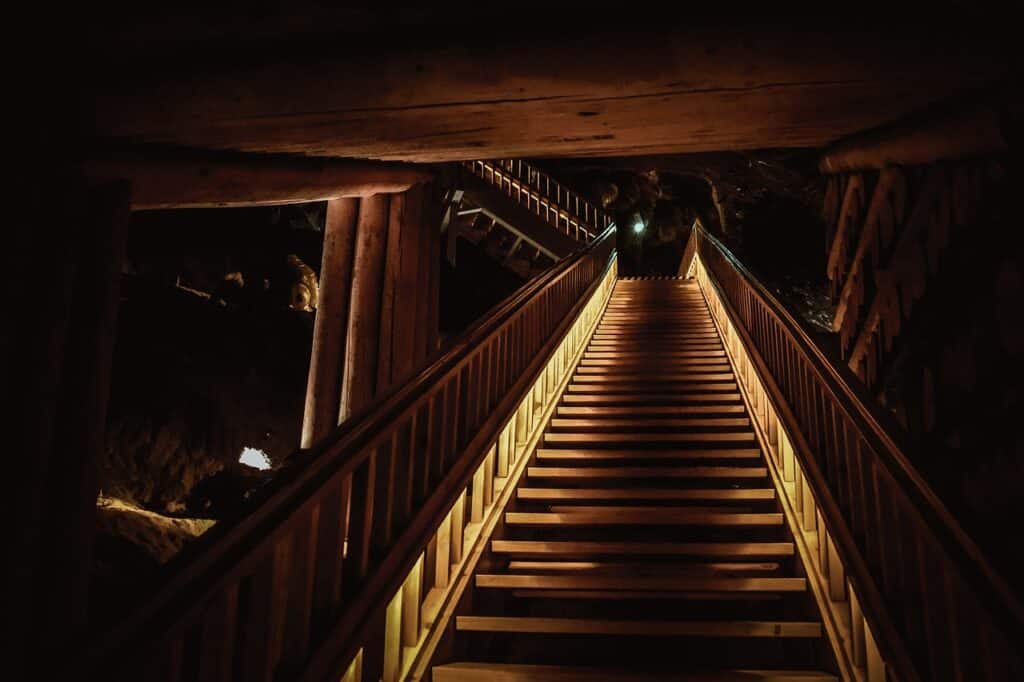
Visitors encounter about 800 steps on the Tourist Route, including roughly 380 during the initial descent.
An Underground Health Resort
Wieliczka also contains an underground medical center at a depth of 135 meters. The Wieliczka Salt Mine Health Resort uses the mine’s stable microclimate as part of programs for people with certain respiratory conditions and allergies.
Its services include supervised treatment stays, pulmonary rehabilitation and overnight programs. This is a medical facility rather than a recreational salt spa. The facility operates as a medical center, so prospective patients should review its requirements and consult an appropriate health professional.
Wieliczka’s underground Health Resort uses the mine’s stable microclimate in supervised respiratory programs.
Beyond the Mine
Wieliczka works well as a day trip from Kraków, but its story deserves more than a rushed photo stop. Above ground, visitors can explore the Saltworks Castle, St. Kinga’s Park and a brine graduation tower.
Kraków adds another layer of Polish history through its medieval center, Jewish heritage, museums and living cultural traditions. Travelers continuing through Poland can also explore Warsaw’s reconstruction after World War II or head south toward the Tatra Mountains between Poland and Slovakia.
Visitors may remember the chandeliers and carved chapels, but Wieliczka began as a workplace. Preserving the mine keeps visible the labor, engineering and faith of generations who built Poland’s salt economy underground.
Find Accommodations in Krakow
Use the search tool below to compare hotels and rentals in Kraków across several booking platforms.
Join the community!
Join our community to receive special updates (we keep your private info locked.)